
Key Takeaways
- Most dead batteries are a connection problem, not a dead cell.
- Overtightening a cart is the most common self-inflicted cause.
- A blinking light usually signals a fault, not an empty battery.
- Debris in the charging port blocks the connection completely.
- Never open, puncture, or modify a vape battery.
- Stop using any device that is swollen, hot, or damaged.
You plug it in. Nothing happens.
The cart is full, the night is planned, and a small piece of hardware has decided otherwise.
Before you buy a replacement, try a few things. Most batteries that seem dead are not, and the fix usually takes about two minutes with something you already own or can pick up alongside your next battery or accessory.
You must be 21 or older to purchase or use these products. Follow the cannabis laws in your state.
Start with the simplest possibilities, because they are also the most common.
First, Rule Out the Obvious
Three of these account for most cases.
- Try a different cable. Charging cables fail more often than batteries do. If a cable only works at a certain angle, it is finished.
- Try a different power source. A wall adapter, a laptop port, and a fast charger all deliver different current. A small vape cell may not respond well to a high-output phone charger.
- Give it longer time. A fully drained battery sometimes shows nothing at all for several minutes before any indicator appears. Leave it fifteen minutes before concluding anything.
Still nothing? The problem is probably not the power. It is probably the connection.
Then Check the Connections
- Look inside the charging port. Pocket lint compacts into charging ports and blocks contact completely. Use compressed air or a dry cotton swab. Never use anything metal.
- Clean the 510 threads and center contact. Oil migrates. A thin film on the center pin breaks the circuit, and a cotton swab clears it in seconds.
- Loosen the cartridge a quarter turn. Overtightening pushes the center pin down far enough to lose contact. This is the single most common self-inflicted failure with 510 devices.
Those three fix more batteries than everything else combined.
Then Check the Device Itself
- Make sure it is actually on. Most vape batteries lock with five rapid clicks and unlock the same way. A locked device looks identical to a dead one.
- Check the temperature. Lithium cells behave badly when very cold or very hot. Let a device that has been in a car or outside return to room temperature before charging.
- Read the light pattern. A blinking LED usually communicates something specific, such as a short, a connection fault, or a protection cutoff. Check the manufacturer’s guidance for your device rather than assuming it means empty.
If none of that works, the cell may genuinely be finished. Before you replace it, one pattern is worth understanding.
Expert Insight: It Is Almost Never the Battery
People replace batteries that work fine. The cell holds a charge, the circuit is intact, and the problem sits in a contact point roughly the size of a pencil eraser.
Two failure points cause most of it. The 510 center pin gets coated with oil that wicked down from the cartridge, or it gets depressed by someone tightening a cart too hard. Both break the circuit and both look exactly like a dead battery.
Here is the tell. If the light comes on but the cart produces no vapor, the cell is working. That is a contact problem, not a power problem.
The cheapest maintenance habit in vaping is wiping the threads with a dry cotton swab whenever you change carts, and keeping a cap on the connection when the device rides in a pocket. Both take seconds and prevent most of what sends people out to buy a replacement.
Snug is tight enough. Every quarter turn past that is working against you.
Some problems are not worth fixing, and a few are worth stopping immediately.
When to Stop Using It Entirely
Vape batteries are lithium-ion cells. The Consumer Product Safety Commission notes hazards associated with batteries and chargers including overheating, fire, thermal burns, and electrical shock, with incidents occurring during use, storage, and charging.
Stop using a device and dispose of it properly if you notice:
| Warning Sign | What It Means |
| Swelling or a bulging case | Cell damage. Stop immediately. |
| Heat while idle or charging | Internal fault |
| Any smell of burning or chemicals | Stop and move it away from anything flammable |
| Visible dents, cracks, or punctures | Compromised cell |
| Very rapid discharge after a full charge | Cell at end of life |
Never open, puncture, or modify a vape battery, including sealed rechargeable disposables. New York State’s lithium-ion battery consumer guide notes that lithium-ion fires spread aggressively, can reignite, and that standard extinguishers do not work on them.
There is no fix inside the case worth that risk. Lithium batteries also do not belong in household trash, so use a battery recycling drop-off.
Prevention costs almost nothing.
Habits That Prevent Most of This
- Wipe the threads when you swap carts. A dry cotton swab, two seconds.
- Cap the connection in a pocket. Lint is the enemy of a 510 thread.
- Stop tightening when it feels snug. Resist the extra turn.
- Keep it out of hot cars. Heat degrades lithium cells permanently.
- Charge where you can see it. Not overnight, not unattended.
- Use the cable intended for the device. Mismatched chargers push the wrong current.
None of that is difficult. It just has to become automatic.
Frequently Asked Questions
How long does a cart battery take to charge? Most vape batteries charge fully in one to three hours depending on capacity. A blinking or color-change indicator typically signals completion, and unplugging then is better for the cell.
Is a blinking light the same as a dead battery? A blinking light usually indicates a specific fault such as a short circuit, a connection problem, or a protection cutoff. Check your device’s guidance rather than assuming it needs charging.
Are all 510 batteries interchangeable? The 510 thread is a shared physical standard, but voltage ranges and activation methods differ. A cartridge may perform differently on another manufacturer’s device.
Is it safe to open a vape battery? Opening, puncturing, or modifying a lithium-ion battery is unsafe and risks fire. This applies to sealed rechargeable disposables as well, which are not designed to be opened.
Is overtightening a cartridge really a problem? Overtightening is the most frequent cause of a cart not firing. Excessive force depresses the center pin far enough to break contact with the battery.
Are vape batteries recyclable? Lithium-ion batteries should go to a battery recycling drop-off rather than household trash. Many hardware stores and municipal facilities accept them.
Conclusion
A battery that seems dead usually is not. Nine times out of ten the problem is a cable, a bit of lint, a film of oil, or a cart tightened half a turn too far.
Work through the list before you spend money. And if the device is swollen, hot, or damaged, stop using it rather than trying to save it.
These products are intended for adults 21 and over. Nothing here is medical advice, and these statements have not been evaluated by the Food and Drug Administration. Follow the cannabis laws in your state.
Keep the Connection Clean
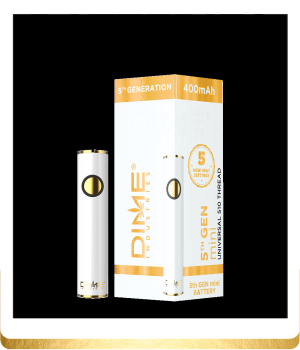
Dime Industries makes the 5th Gen battery and the 5th Gen Mini, along with the cotton swabs and silicone caps that prevent most of the problems above. Browse the accessories lineup to see what fits your setup.
Use the store locator to find a licensed dispensary near you. Adults 21+.